
Best Solar Panel Direction and Tilt Angle in Kerala: Complete Guide
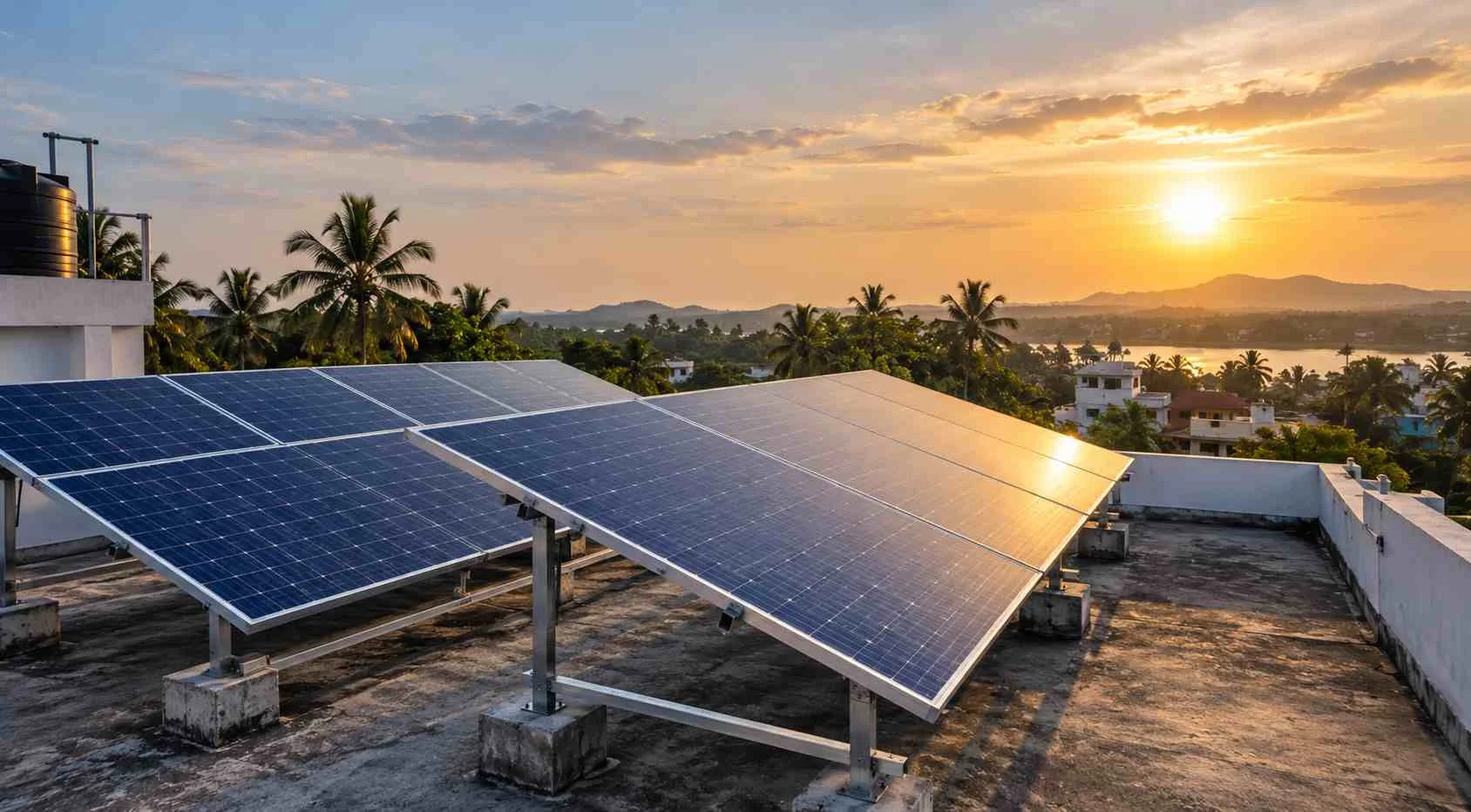
Choosing suitable solar panels is only one part of planning a rooftop solar system. The direction in which the panels face, their inclination, surrounding shade and the amount of usable roof space can all influence the performance of the final installation.
For homeowners and businesses researching the best solar panel angle in Kerala, one question comes up frequently:
What angle should solar panels be installed at?
There isn’t one fixed number that is correct for every property.
A property’s geographical location provides a useful starting point, but rooftop design also needs to account for roof orientation, existing slope, nearby obstructions, available installation area and spacing between panel rows.
The same principle applies to direction. South is an important reference orientation for fixed solar arrays in the Northern Hemisphere, but a southeast-, southwest-, east- or west-facing roof should not automatically be considered unsuitable.
Quick Answer: There is no single tilt angle that is ideal for every rooftop in Kerala. The site’s latitude can provide an initial reference when evaluating a fixed solar array, while south is a conventional reference direction in the Northern Hemisphere. The final layout should also account for roof slope, orientation, shading, row spacing and usable roof area.
This guide explains solar panel direction and tilt angle in Kerala, the meaning of azimuth, the effect of shading and roof geometry, and why a theoretical optimum does not always translate into the most practical rooftop layout.
What Is Solar Panel Tilt Angle?
The solar panel tilt angle describes how far a panel is inclined from the horizontal.
For example, a module lying completely level on a flat surface would have a tilt of approximately 0°. Raising one side increases its inclination.
Why is this relevant?
The sun does not remain in the same position in the sky. Its position changes during the day and across the seasons. As a result, the orientation of a module influences how solar radiation reaches its surface.
For a fixed photovoltaic array, geographical location is therefore one of the considerations used when evaluating tilt.
The latitude of the installation site can provide an initial reference for a fixed array. However, it should not be treated as an automatic installation specification.
The final arrangement should also be considered in relation to roof orientation, shading, available space and the overall array layout.
What Is Solar Panel Direction or Azimuth?
Tilt and direction describe two different aspects of a solar array.
Tilt tells us how far the module is inclined from horizontal.
Azimuth identifies the compass direction toward which the array faces.
In the convention used by PVWatts, for example:
- 0° = North
- 90° = East
- 180° = South
- 270° = West
The official PVWatts system design documentation explains the orientation parameters used when describing photovoltaic arrays.
Two arrays could therefore have identical tilt angles but face different compass directions. Their exposure to sunlight at different times of the day would not necessarily be the same.
When evaluating a rooftop, think about both questions:
Panel tilt → How far is the panel inclined?
Panel azimuth → In which direction does the panel face?
Considering only one of these factors gives an incomplete picture of the array orientation.
What Is the Best Direction for Solar Panels in Kerala?
Kerala lies in the Northern Hemisphere. For a fixed photovoltaic array north of the equator, south is commonly used as a reference orientation.
Under the convention used by PVWatts, a south-facing array north of the equator has an azimuth of 180°.
However, that does not mean:
“A rooftop must face perfectly south to use solar panels.”
Actual rooftops rarely offer perfect theoretical conditions.
One house may have a southeast-facing sloped roof. Another may have a large southwest-facing section. A property with a flat RCC terrace may provide considerably more freedom in deciding how an array is positioned.
Roof usability can also be affected by:
- nearby buildings;
- trees;
- water tanks;
- parapet walls;
- rooftop rooms;
- antennas and other structures; and
- the amount of relatively shade-free installation space.
Instead of asking only, “Does my roof face south?”, it is more useful to ask:
“Which part of my roof provides a practical combination of solar exposure, orientation, limited shading and usable installation area?”
The answer depends on the property itself.
Homeowners considering an on-grid solar system in Kerala should therefore consider roof orientation and shading as part of the broader system-planning process.
What Is the Best Solar Panel Angle in Kerala?
There is no universal solar panel angle in Kerala that should automatically be applied to every installation.
For a fixed array designed around year-round electricity generation, site latitude can serve as an initial reference when examining tilt. The actual panel inclination can vary depending on the requirements and physical conditions of the project.
That distinction is important.
Consider two houses located close to one another. Their geographical latitude may be virtually identical, but their rooftops can be completely different.
One might have a spacious, open terrace. The other could have a sloped roof affected by trees, a water tank and surrounding construction.
Using exactly the same layout for both would ignore those differences.
Factors that can influence the final configuration include:
- geographical location;
- existing roof slope;
- roof orientation;
- usable shade-free space;
- surrounding obstructions;
- distance between panel rows;
- available roof area;
- mounting arrangement; and
- the objectives of the overall solar system.
The optimum tilt angle for solar panels should therefore be considered as one component of the complete rooftop design rather than selected from a generic angle chart.
Why Isn’t There One Perfect Angle for Every Kerala Roof?
Consider two simple examples.
Property A: Large Open Terrace
Imagine a home with a spacious flat RCC terrace, few surrounding obstructions and little significant daytime shading.
Such a property can provide considerable flexibility when evaluating panel orientation, inclination and spacing.
Property B: Smaller Roof with Obstructions
Now imagine another house in the same area.
A water tank occupies part of its rooftop. There is also a rooftop room, a nearby tree affecting morning sunlight and a parapet limiting part of the usable area.
Both properties experience similar regional solar conditions, yet their practical solar layouts could be quite different.
This illustrates an important point:
Rooftop solar design is not simply about finding one mathematical angle.
The objective is to make effective use of the available roof while maintaining appropriate solar access and accounting for the property’s physical constraints.
South vs East vs West: Does Solar Panel Direction Matter?
Yes. The direction of an array affects when it receives more direct solar exposure during the day.
South-Facing Solar Panels
South is the conventional reference direction for a fixed solar array in the Northern Hemisphere.
Where roof geometry and surrounding conditions allow it, a suitable south-facing arrangement can provide favourable exposure for annual solar generation.
However, south should be treated as a useful design reference rather than a rule that automatically excludes other orientations.
East-Facing Solar Panels
East-facing arrays generally receive more direct solar exposure during the morning.
If the most usable portion of a roof faces east, it can still be evaluated for rooftop solar. Its expected production should be assessed according to the actual orientation and site conditions rather than assuming that an east-facing roof has no solar potential.
West-Facing Solar Panels
West-facing arrays generally receive more direct solar exposure during the afternoon.
A west-facing roof may therefore still provide useful generation potential depending on its shading, usable area and the objectives of the installation.
Southeast- and Southwest-Facing Solar Panels
Many buildings are not aligned exactly north, south, east or west.
Southeast- and southwest-facing sections can also be evaluated for solar. Their expected performance depends on the actual azimuth, inclination, surrounding shade and local solar conditions.
The sensible approach is therefore to evaluate the available rooftop rather than reject it solely because of its compass direction.
How Does Tilt Angle Affect Solar Panel Output?
Photovoltaic modules generate electricity from solar radiation reaching their surface.
Changing the angle of a module changes its relationship with incoming sunlight. Its solar exposure can therefore vary across different times of the day and year.
This is why panel inclination can influence energy production.
However, the angle that looks favourable for one individual module does not automatically create the most effective layout for the whole rooftop.
Changing tilt can also change:
- the height of a panel row;
- the shadow behind that row;
- the spacing needed between adjacent rows;
- how many modules can be accommodated; and
- the geometry of the complete array.
Solar design therefore needs to be considered at the system level, not only one module at a time.
Is the Maximum-Generation Angle Always the Best Installation Angle?
Not necessarily.
This becomes particularly important on flat terraces where several rows of tilted modules are required.
As the tilt increases, the upper edge of a row becomes higher. Depending on the sun’s position, this can increase the length of the shadow behind that row.
If another row is installed within the shaded area, its solar exposure can be affected.
Moving the next row farther away may reduce self-shading, but wider gaps also consume more rooftop space.
This creates a design trade-off.
Greater tilt can increase row height and potentially require additional separation.
Lower tilt can reduce row height and may allow a different spacing arrangement.
Neither option is automatically superior.
The important point is that tilt, spacing and usable roof area should be considered together.
Why Shading Can Matter More Than a Small Difference in Tilt
It is easy to focus on whether a panel should be inclined a few degrees more or less while overlooking a potentially larger issue: shade.
Selecting an appropriate angle cannot eliminate persistent obstruction from nearby objects.
Potential sources of rooftop shade can include:
- coconut and other tall trees;
- neighbouring buildings;
- water tanks;
- rooftop rooms;
- parapet walls;
- antennas;
- utility structures; and
- adjacent rows of solar modules.
This is why a rooftop assessment should consider where shadows fall and how they change rather than focusing only on a theoretical tilt value.
Solar Panel Tilt and Row Spacing
Tilt and row spacing are closely connected when modules are arranged in multiple rows.
Imagine one tilted row positioned in front of another.
When the sun is relatively high, the shadow behind the first row may be shorter. At lower solar positions, that shadow can extend farther.
If the next row sits within that shaded zone, its available sunlight can be reduced.
Increasing the separation between rows can help, but every additional gap also consumes roof space.
Changing tilt can alter the row height and therefore change the shadow geometry as well.
Instead of asking only:
“Which tilt gives the highest theoretical output?”
a more complete design question is:
“Which combination of tilt, direction, spacing and module placement makes effective use of this rooftop?”
Flat Roof vs Sloped Roof: Does Roof Type Affect Solar Panel Angle?
Yes. Existing roof geometry can influence how an array is positioned.
Solar Panels on a Flat RCC Roof
A flat terrace generally provides more flexibility because the mounting arrangement can establish both the direction and inclination of the modules.
That flexibility does not mean every position is equally suitable.
The layout can still be affected by:
- shading;
- spacing between rows;
- roof access;
- structural considerations;
- wind exposure;
- drainage;
- existing rooftop equipment; and
- available installation area.
The complete roof should therefore be considered when determining the array layout.
Solar Panels on a Sloped Roof
A sloped roof already has its own inclination and compass orientation.
Depending on the roof and mounting arrangement, the modules may follow or remain relatively close to the existing roof plane.
Trying to force every sloped rooftop to match a theoretical tilt could increase mounting complexity without necessarily creating the most practical overall layout.
The existing slope, direction, shading and expected production should instead be considered together.
Does Kerala’s Monsoon Change the Best Solar Panel Angle?
Kerala’s climate is an important part of rooftop planning, but claims about one special “monsoon solar-panel angle” should be treated cautiously.
According to the India Meteorological Department’s monsoon-onset information, the normal onset of the southwest monsoon over Kerala is around the beginning of June, while the actual onset can vary from year to year.
Seasonal weather is relevant to rooftop solar, but panel inclination should not be selected from a supposed universal monsoon angle.
The overall installation should also account for the physical conditions of the property, including weather exposure, mounting, structural requirements and drainage.
The appropriate tilt still needs to form part of the complete site-specific design.
Can Solar Panels Be Installed Completely Flat?
A completely horizontal installation may initially appear attractive on a flat terrace because it keeps the mounting arrangement low.
However, a 0° tilt should not automatically be assumed to be the most appropriate option.
Tilt changes the orientation of the module relative to incoming sunlight and can also affect practical considerations such as water movement across its surface.
A flat building roof therefore does not automatically mean the modules themselves should be installed flat.
Possible configurations should be evaluated according to the property’s actual conditions.
How Do Professionals Determine the Right Solar Panel Angle?
A rooftop assessment should start with the property rather than with a predetermined angle.
Several connected factors can be considered.
1. Identify the Site Location
Geographical location establishes latitude and provides a basis for analysing solar resources and the sun’s position.
2. Determine Roof Orientation
The direction of each usable roof surface can be identified to understand the available array azimuth.
3. Examine the Existing Roof Slope
A sloped roof already provides an inclination that may influence module positioning.
A flat terrace generally provides more flexibility through the mounting arrangement.
4. Assess Shading
Trees, neighbouring buildings, water tanks, parapets, rooftop rooms and other structures can affect solar access.
Because shadows move as the sun’s position changes, viewing a roof at only one time of day may not provide the complete picture.
5. Determine Usable Roof Area
Total roof area and usable installation area are not necessarily identical.
Obstructions, access requirements, rooftop equipment and shaded areas can reduce the space practically available for modules.
6. Evaluate Tilt and Azimuth
Different combinations of inclination and direction can then be considered.
7. Check Inter-Row Shading
Where several rows are required, row height, inclination and spacing need to be evaluated together.
8. Estimate Energy Production
Solar-performance tools can be useful for comparing potential system configurations.
The official PVWatts Calculator provides estimates of photovoltaic energy production using location and system-design inputs.
9. Finalize the Rooftop Layout
The final configuration should balance expected production with roof geometry, available space, shading, mounting requirements and other site-specific considerations.
Can You Calculate Solar Panel Tilt Angle Yourself?
A homeowner can estimate a preliminary tilt reference, but an estimate should not be confused with a completed rooftop design.
For a fixed array, site latitude can be used as an initial reference. The actual project angle may differ depending on the physical conditions and requirements of the installation.
This makes latitude-based calculations useful for understanding the concept.
A solar panel tilt angle calculator in India can similarly help with preliminary comparisons.
However, a calculator cannot automatically understand every physical condition of a particular property.
For example, it may not know that:
- a water tank creates afternoon shade;
- a neighbouring building obstructs morning sunlight;
- a tree affects one section of the roof;
- a parapet shades part of the array;
- the existing roof has a particular slope; or
- a different arrangement could make better use of the available space.
Calculators are therefore useful planning tools, but they should not be treated as substitutes for evaluating the actual rooftop.
Common Solar Panel Direction and Tilt Mistakes
Copying the Angle Used by a Neighbour
Two properties on the same street can have different roof slopes, surrounding structures, usable areas and shading patterns.
A neighbouring installation is not automatically the correct template for another building.
Ignoring Shading
A favourable compass direction cannot remove persistent shading caused by a tree, nearby building or rooftop obstruction.
Shade should be considered during system planning.
Considering Tilt but Ignoring Direction
Tilt and azimuth describe different aspects of array orientation.
Both matter when evaluating how an array is positioned.
Ignoring Row-to-Row Shading
Rows positioned too close together can shade one another under certain solar conditions.
Spacing and tilt therefore need to be considered together.
Chasing a “Perfect Angle” While Ignoring the Whole Roof
The theoretical exposure of an individual panel is not the only consideration.
A configuration that requires excessive spacing or creates avoidable shading may make poorer use of the overall rooftop than another arrangement.
Treating a Solar Calculator as the Final Design
Solar calculators are useful for estimates and comparisons.
They do not physically inspect the property.
Final planning should account for the actual building and its surroundings.
So, What Is the Best Solar Panel Angle in Kerala?
For someone searching for one universal number, the answer may seem less straightforward, but it is more useful:
There is no single solar panel angle that is automatically best for every property in Kerala.
Instead, consider the following framework:
Direction: South is a conventional reference orientation for fixed photovoltaic arrays in the Northern Hemisphere.
Tilt: Site latitude can provide an initial reference when examining a fixed array, but it is not an automatic final setting.
Shading: Trees, buildings, tanks, parapets and other obstructions should be considered.
Row spacing: Tilt and row separation need to be evaluated together where multiple rows are used.
Roof design: Existing slope, orientation and usable installation area can influence the final configuration.
Final layout: The array should be planned around the conditions of the actual property rather than copied from a generic tilt chart.
Panel orientation should also be considered alongside the type of solar system being planned. Property owners comparing system options can learn more about a hybrid solar system in Kerala.
Ultimately, the best solar panel angle in Kerala is site-specific.
A thoughtful rooftop design considers direction, inclination, shading, spacing and usable area together rather than treating one angle as the answer to every installation.
Frequently Asked Questions
What is the best angle for solar panels in Kerala?
There is no universal tilt angle for every Kerala rooftop. Site latitude can provide an initial reference for a fixed array, but the final configuration should also account for roof slope, orientation, shading, usable area and row spacing.
Which direction should solar panels face in Kerala?
South is a conventional reference direction for fixed photovoltaic arrays in the Northern Hemisphere. Southeast-, southwest-, east- and west-facing roof sections can also be evaluated according to their actual orientation, shading and expected generation.
What is solar panel azimuth?
Azimuth describes the compass direction in which a solar array faces. Under the convention used by PVWatts, 0° represents north, 90° east, 180° south and 270° west.
Is solar panel tilt the same as solar panel direction?
No. Tilt describes the panel’s inclination relative to horizontal. Azimuth describes the compass direction toward which the array faces.
Does solar panel angle affect power generation?
Yes. Array orientation affects how solar radiation reaches the module surface. Overall system performance, however, also depends on other factors such as shading, weather conditions, equipment and array design.
How do I calculate the tilt angle of a solar panel?
Site latitude can be used as an initial reference when considering a fixed array, but the resulting configuration should also be evaluated against the property’s roof direction, slope, shading, available area and row spacing.
Is south-facing mandatory for rooftop solar in Kerala?
No. South is an important reference direction, but other orientations can also be evaluated for rooftop solar. Suitability depends on the conditions of the particular property.
Can solar panels face east or west?
Yes. East-facing arrays generally receive more direct exposure during the morning, while west-facing arrays receive more during the afternoon. Their overall suitability depends on the site’s roof geometry, shading and design objectives.
Should solar panels be completely flat on a flat roof?
Not automatically. A flat terrace provides flexibility to establish module inclination through the mounting arrangement. Solar exposure, shading, spacing, drainage and other rooftop conditions should be considered when selecting the final configuration.
Does Kerala’s monsoon require a different solar panel angle?
There is no universal “monsoon angle” that applies to every Kerala rooftop. Seasonal weather should be considered within the overall system and structural design, while panel tilt should still be evaluated according to the individual site.
Plan Your Rooftop Solar System with Rumion Power India
A suitable rooftop solar layout begins with understanding the property.
Panel direction, inclination, shading, usable roof space and overall system arrangement should be considered together before an installation is finalized.
If you are planning a residential or commercial rooftop solar system in Kerala, contact Rumion Power India to discuss your rooftop solar requirements.
Request a Rooftop Solar Assessment