
Solar Earthing in Kerala: Types, Requirements & Safety Guide
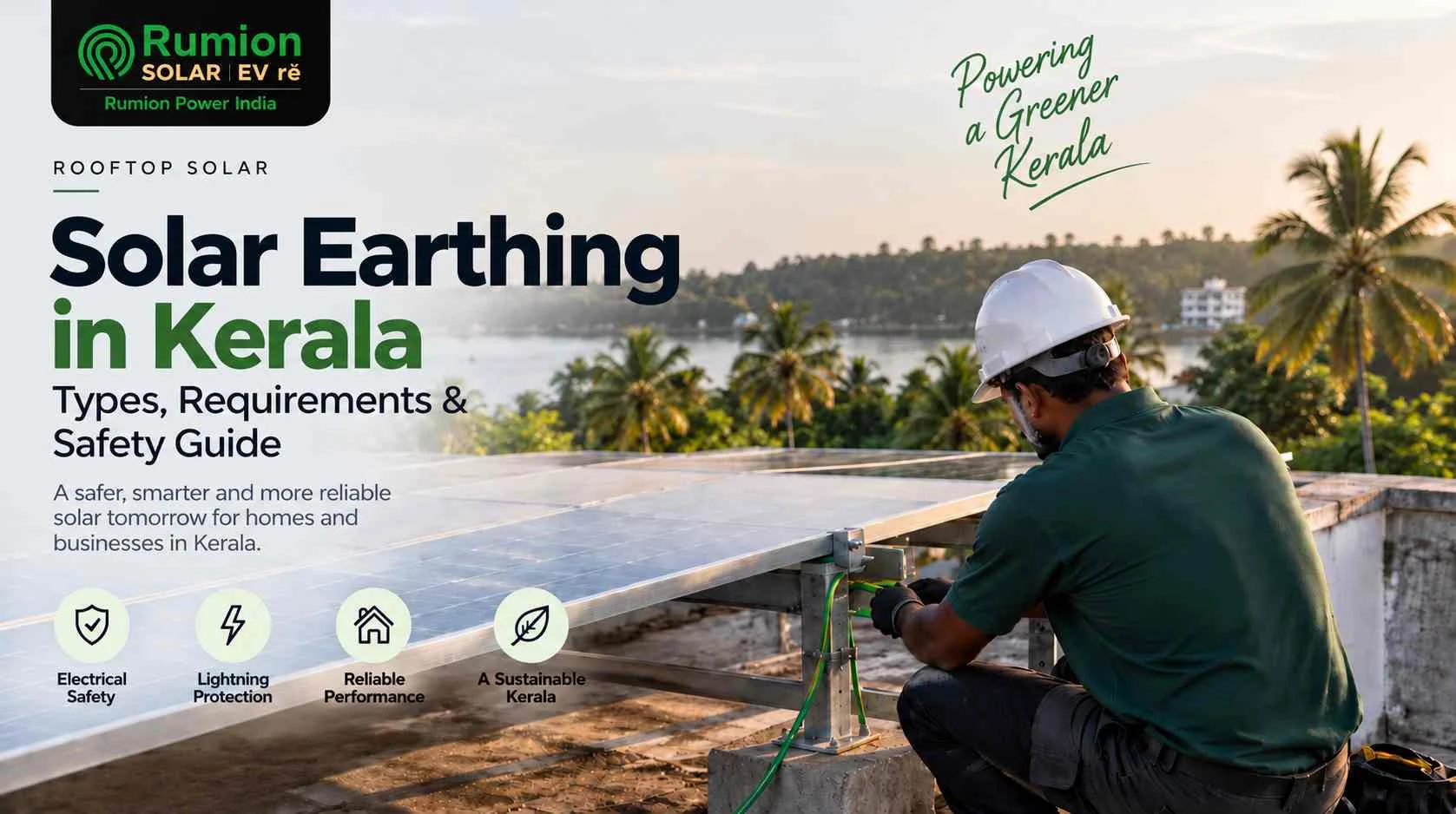
Solar earthing in Kerala is an important part of a safe and properly designed rooftop solar system. Installing rooftop solar involves much more than placing solar panels on a roof and connecting them to an inverter. A complete solar installation also includes mounting structures, cables, electrical protection equipment, earthing, testing and commissioning.
Earthing provides an intentional connection between relevant conductive parts of a solar installation and the earth. When properly designed and installed, it forms part of the system’s protection against electrical faults and potentially dangerous voltages.
For homeowners and businesses planning rooftop solar in Kerala, earthing should therefore be considered during system design—not treated as an optional accessory added after installation.
India’s electrical-safety framework contains specific requirements relating to solar-installation earthing, while KSEB’s rooftop-solar inspection documentation also includes earthing and earthing cable or strip among the components of a standard rooftop solar package.
If you are planning a complete solar project, you can also explore Rumion Power India’s solar services in Kerala to understand how site assessment, system design, installation, electrical protection, testing and commissioning fit together.
What Is Solar Earthing?
Solar earthing, sometimes referred to as grounding, is the process of connecting specified conductive parts of a solar PV installation to an earthing system.
Its primary purpose is electrical safety.
A rooftop solar installation contains several conductive components, including module mounting structures, equipment enclosures and inverter cabinets. Appropriate earthing and bonding help incorporate these components into the installation’s overall protective arrangement.
The Central Electricity Authority (CEA) addresses earthing specifically in its safety regulations for solar installations.
The regulations cover earthing of relevant metal casing and shielding, PV array structures, equipment, inverters and control systems, along with applicable non-current-carrying metallic parts.
For the regulatory reference, see the CEA Measures Relating to Safety and Electric Supply Regulations, 2023.
Solar earthing should therefore be viewed as an integral part of electrical system design rather than simply an earth wire connected somewhere near the panels.
Why Is Earthing Important in a Rooftop Solar System?
Solar PV systems operate outdoors for many years and include both DC and AC electrical sections.
Their components can be exposed to sunlight, rain, humidity and changing environmental conditions. Electrical faults or insulation problems can also occur during the operating life of the installation.
Earthing forms one layer of the overall electrical-protection strategy.
A correctly engineered solar installation needs to consider protection against electrical faults, unwanted potential on accessible conductive parts, abnormal electrical conditions and lightning- or surge-related risks where applicable.
The CEA’s solar-safety provisions address not only earthing but also lightning and over-voltage protection, surge protection, earth-fault protection and insulation monitoring.
This is why a professionally planned rooftop solar system should consider electrical protection as part of the complete system rather than treating earthing as an isolated component.
Rumion’s solar installation services in Kerala likewise cover system planning, electrical protection, installation, testing and commissioning as parts of the overall project process.
Which Parts of a Solar System Need Earthing?
The exact earthing design depends on the solar system configuration, equipment, site conditions and applicable technical requirements.
This means homeowners should not assume that every rooftop solar installation will use an identical earthing arrangement.
However, several important areas need to be considered.
1. Solar Panel Mounting Structures
Solar modules are normally secured to metallic mounting structures.
The CEA’s solar safety requirements include PV array structures and applicable non-current-carrying metallic parts within the earthing provisions.
Proper bonding and earthing of the relevant metallic structures therefore form part of the overall electrical-safety design.
This is also one reason why the quality of a rooftop solar installation depends on much more than the solar panels themselves.
2. Solar Inverter
The inverter is another important part of the protective earthing arrangement.
The inverter converts DC electricity generated by the solar panels into AC electricity suitable for the connected electrical system.
The CEA regulations include requirements relating to inverter earthing. The appropriate connection should therefore be made according to the applicable technical requirements and the inverter manufacturer’s instructions.
For Kerala homeowners comparing different system configurations, Rumion’s guide on whether on-grid solar works during a power cut also explains the role of the inverter and electrical protection in grid-connected solar systems.
3. Other Metallic Equipment and Enclosures
Applicable equipment frames, cabinets, chassis and other non-current-carrying metallic parts also need to be considered as part of the protective arrangement.
The objective is to create a coordinated electrical-protection system rather than leaving individual conductive components electrically unrelated.
AC Earthing and DC-Side Considerations
A rooftop solar installation contains both DC and AC sections.
Solar panels generate direct current (DC). The inverter then converts that electricity into alternating current (AC) for use by the property and, in a grid-connected system, interaction with the electricity network.
Because inverter technology and solar system architectures vary, the correct protective arrangement cannot safely be determined from a generic diagram found online.
The appropriate design needs to consider:
- the PV array;
- inverter configuration;
- AC electrical system;
- DC electrical system;
- protective equipment;
- mounting structures;
- applicable standards; and
- equipment manufacturer requirements.
For homeowners, the useful question is therefore not:
“Can my installer copy this solar earthing diagram?”
A better question is:
“Has the complete earthing and electrical-protection arrangement been designed and tested for my particular solar installation?”
Solar Earthing and Lightning Protection Are Not the Same Thing
This distinction is important.
Protective earthing and lightning protection are related, but they are not interchangeable.
The CEA addresses lightning and over-voltage protection separately alongside its earthing requirements for solar installations.
KSEB’s indicative bill of materials for a standard rooftop solar package also lists Earthing and Lightning Arrestor as separate items.
That means the presence of an earth connection does not automatically establish that the complete lightning- and surge-protection arrangement is adequate.
For Kerala installations, this distinction is especially useful for consumers reviewing quotations. An installer should be able to explain what is being provided for:
- equipment and structural earthing;
- lightning protection;
- surge protection; and
- other applicable electrical protection.
These should not simply be grouped together under an unexplained line item called “safety.”
How Many Earth Pits Are Required for a Solar System?
This is one of the most common questions people ask about solar earthing.
You may find online articles claiming that every solar installation requires a fixed number of earth pits.
That is too simplistic.
The current CEA solar-safety provisions call for an adequate number of interconnected earth pits and require the relevant spacing between earth pits to follow the applicable standard.
Therefore, it would be misleading to say that every 3 kW, 5 kW or 10 kW rooftop solar installation in Kerala automatically requires exactly the same number of earth pits.
The final arrangement can depend on factors such as:
- system design;
- applicable standards;
- site conditions;
- protection architecture;
- equipment configuration; and
- project-specific requirements.
If a solar quotation lists a particular number of earth pits, ask the installer to explain why that arrangement has been selected for your project.
Do not select a solar installer merely because one quotation shows more earth pits than another.
What Are the Types of Earthing Used in Solar Installations?
People frequently search for types of earthing for solar systems, but this phrase can create confusion because earthing can be classified differently depending on the engineering context.
For a homeowner, understanding the function is generally more useful than memorising technical categories.
Depending on the installation, the overall protective design may need to address:
Equipment Protective Earthing
Applicable equipment enclosures and metallic components need to be incorporated into the protective earthing arrangement.
Solar Module and Mounting Structure Earthing
Relevant conductive module structures and mounting components need to be properly bonded and incorporated into the protection scheme.
Inverter Earthing
The inverter’s protective earthing arrangement must follow applicable requirements and manufacturer instructions.
Lightning Protection
Where required, lightning protection forms a separate but coordinated part of the installation’s overall protection strategy.
Equipotential Bonding
Relevant conductive parts may need to be bonded so that the protective arrangement works as intended.
The physical electrode and conductor arrangement should ultimately be selected according to the applicable technical standards and project conditions.
Which Earthing Wire Is Best for Solar Panels?
There is no single earthing-wire size that should be recommended universally for every rooftop solar installation.
Conductor selection depends on the electrical design and applicable requirements.
Factors may include:
- the component being earthed or bonded;
- system configuration;
- applicable electrical standards;
- conductor material;
- environmental exposure;
- equipment requirements;
- conductor routing; and
- protection design.
KSEB’s rooftop-solar inspection documentation lists Earthing Cable / Strip but refers its specification to applicable MNRE requirements rather than providing homeowners with one universal conductor size.
You can review this directly in KSEB’s Documents Required for Inspection Approval.
This is why copying an earthing-wire size from a YouTube video, blog article or another rooftop installation is not a good substitute for project-specific electrical design.
What About Solar Earthing Resistance?
Earth resistance is another subject where generic online advice can be misleading.
A single numerical value should not automatically be presented as the mandatory limit for every possible rooftop solar installation.
The appropriate requirements and testing criteria should be determined from the applicable standards and project design.
For homeowners, the important point is simpler:
Earthing should not merely be installed—it should also be appropriately inspected and tested.
The completed solar system should undergo the required electrical checks before commissioning.
KSEB’s rooftop-solar inspection documentation specifically includes Installation Testing & Commissioning according to applicable safety norms.
Why Solar Earthing Matters for Rooftop Solar in Kerala
The electrical principles behind solar earthing are not unique to Kerala.
What makes this article Kerala-specific is the local rooftop-solar environment and the process followed for grid-connected installations.
KSEB operates the Solar Rooftop Portal – Kerala for grid-connected rooftop PV applications and provides information for consumers and developers.
KSEB also states that project developers should adhere to applicable national and international standards specified by MNRE and CEA together with the relevant Kerala regulatory framework.
For homeowners planning a grid-connected system, understanding the local approval process is just as important as choosing panels and an inverter.
Rumion’s guide to the KSEB solar feasibility check explains the feasibility, application and approval side of a rooftop solar project in Kerala.
Solar Earthing and Kerala’s Climate
Kerala rooftop solar installations operate outdoors and can experience periods of heavy rainfall, high humidity and prolonged environmental exposure.
These conditions make overall installation quality important.
A solar installation should therefore consider appropriate:
- equipment selection;
- corrosion protection;
- cable routing and management;
- weather-resistant connections;
- mounting quality;
- drainage;
- periodic inspection; and
- preventive maintenance.
However, Kerala’s climate does not justify inventing a special earthing resistance value, fixed conductor size or universal number of earth pits.
Those requirements still need to be determined according to the applicable technical standards and the specific installation.
Solar Earthing for On-Grid Systems in Kerala
On-grid solar systems remain connected to the electricity network during normal operation.
This makes proper system protection, inverter configuration and grid-interface requirements especially important.
For example, a standard grid-connected inverter is designed to stop supplying power when the utility grid goes down. This anti-islanding behaviour helps protect people and equipment associated with the network.
If you are considering an on-grid system, read Does On-Grid Solar Work During a Power Cut? for a detailed explanation of this behaviour.
Earthing is one part of this broader electrical-safety architecture; it does not replace inverter protection, isolation, surge protection or other required protective functions.
Solar Earthing for Hybrid Systems
Hybrid solar systems combine solar generation with battery storage and grid connectivity in suitable configurations.
Because batteries and additional power electronics can make the system architecture more complex, the electrical design should reflect the actual equipment and operating configuration.
Homeowners considering battery backup can explore Rumion’s hybrid solar solutions in Kerala to understand how solar generation, battery storage and grid electricity can work together.
The earthing arrangement for any particular hybrid installation should follow the applicable system design and equipment requirements rather than simply copying the layout of a standard on-grid installation.
What Should Be Checked Before a Rooftop Solar System Is Commissioned?
A homeowner does not need to become an electrical engineer to ask sensible questions.
Before commissioning, ask whether the installer has properly addressed:
- applicable module mounting structure earthing;
- inverter protective earthing;
- relevant metallic equipment and enclosures;
- continuity of protective conductors and connections;
- appropriate lightning protection;
- appropriate surge protection;
- secure and durable electrical connections;
- required inspection and testing;
- system documentation; and
- applicable grid-connection requirements.
KSEB’s indicative rooftop solar package includes Installation Testing & Commissioning according to applicable safety norms, reinforcing that installation is not complete merely when the panels start producing electricity.
Common Solar Earthing Mistakes to Avoid
Treating Earthing as a Last-Minute Addition
Earthing should be considered during system design rather than added casually after panels and the inverter have already been installed.
Assuming Every Property Needs the Same Design
A configuration used for one house should not automatically be copied to another property.
Using a Generic Online Diagram as the Final Design
Online diagrams can help explain concepts, but they should not replace project-specific engineering.
Ignoring Mounting Structure Bonding
The solar mounting structure is part of the installation and should be considered in the protective arrangement where applicable.
Confusing Earthing With Lightning Protection
They are related but distinct elements of electrical safety.
Focusing Only on the Number of Earth Pits
More earth pits do not automatically mean a better installation. The complete design, interconnection, testing and compliance matter.
Skipping Testing
A visually complete earth connection does not by itself prove that the protective system is functioning as intended.
Can Solar Earthing Be a DIY Project?
For a grid-connected rooftop PV installation, solar earthing should be treated as professional electrical work.
Incorrect design or connections can undermine electrical protection and create risks to people and equipment.
Kerala’s grid-connected rooftop systems also operate within a defined utility and regulatory framework.
KSEB states that rooftop solar applications are processed through its solar rooftop system and that applicable projects must meet relevant technical requirements.
Homeowners should understand enough to ask informed questions, but the actual design, installation and testing should be handled by appropriately qualified professionals.
Solar Earthing Cost in Kerala
There is no single reliable solar earthing cost in Kerala that applies to every rooftop.
The final cost can vary depending on:
- system capacity and configuration;
- required earthing arrangement;
- electrode or pit requirements;
- conductor material and length;
- cable or strip routing;
- civil work;
- site conditions;
- lightning-protection requirements;
- electrical-protection equipment; and
- testing requirements.
For this reason, homeowners should be cautious about advertisements offering a universal earthing price without inspecting the site or understanding the solar system.
When comparing quotations, check what is included, not just the final amount.
If you are evaluating a complete rooftop project, Rumion’s solar services in Kerala explain the broader process from site assessment and system design through installation, testing and after-sales support.
Solar Earthing Checklist for Kerala Homeowners
Before approving or accepting a rooftop solar installation, ask your installer:
- Which parts of my solar system will be earthed?
- How was the earthing arrangement selected for this property?
- How will the module mounting structures be bonded?
- How will the inverter be protectively earthed?
- What lightning protection is being provided?
- What surge protection is included?
- Which applicable standards and manufacturer requirements are being followed?
- What tests will be performed before commissioning?
- Will I receive the relevant test and system documentation?
- What parts of the earthing and protection system should be inspected during future maintenance?
These questions are considerably more useful than simply asking:
“How many earth pits are you giving me?”
Solar Earthing vs Normal Home Earthing
A rooftop solar PV system does not simply replace the building’s existing electrical safety arrangements.
Instead, solar introduces additional equipment and conductive components that need to be incorporated into an appropriately designed electrical-protection system.
These can include:
- PV modules;
- metallic mounting structures;
- inverter;
- DC cabling;
- AC cabling;
- distribution and protection equipment; and
- other associated electrical components.
This is why installing rooftop solar should not be approached in the same way as plugging another household appliance into an existing socket.
The complete PV system needs to be properly planned, protected, installed and tested.
Frequently Asked Questions About Solar Earthing in Kerala
Is earthing required for solar panels?
Solar installations are subject to earthing requirements under India’s electrical-safety framework. The CEA’s solar provisions address PV array structures, equipment, inverter and control systems, and applicable non-current-carrying metallic components.
How many earth pits are required for a solar system?
There is no responsible universal number that should be applied to every rooftop system. The CEA calls for an adequate number of interconnected earth pits and requires relevant spacing to follow the applicable standard. The final arrangement should therefore be determined for the particular installation.
Does a solar inverter require earthing?
The inverter forms part of the solar installation’s protective earthing considerations. Its earthing should follow applicable electrical requirements and the equipment manufacturer’s instructions.
Is lightning protection the same as solar earthing?
No. They are related aspects of electrical protection, but they are not the same thing. CEA addresses lightning and over-voltage protection separately alongside solar earthing requirements, and KSEB’s indicative rooftop package separately lists earthing and a lightning arrestor.
Which earthing wire should be used for solar panels?
There is no single conductor size that should be recommended for every solar installation. Conductor selection should follow the applicable standards, electrical design and equipment requirements.
Is solar earthing required for rooftop systems in Kerala?
Grid-connected rooftop solar installations in Kerala operate within applicable electrical-safety and grid-connectivity requirements. KSEB’s rooftop documentation specifically includes earthing in its indicative bill of materials.
Should solar earthing be tested?
Yes. Appropriate inspection, testing and commissioning form an important part of completing a rooftop solar installation. KSEB’s indicative package explicitly includes installation testing and commissioning according to applicable safety norms.
Can I install solar earthing myself?
For a grid-connected rooftop solar system, the design, installation and testing of electrical protection should be handled by appropriately qualified professionals rather than treated as a DIY project.
Does every 3 kW or 5 kW solar system use the same earthing arrangement?
Not necessarily. Solar capacity alone does not determine every aspect of the earthing design. Site conditions, equipment configuration, applicable standards and the overall electrical-protection scheme also need to be considered.
How much does solar earthing cost in Kerala?
There is no universal price. Cost varies according to the design, materials, conductor length, civil work, site conditions, protection requirements and testing involved in the project.
Final Thoughts
Solar earthing may not be the most visible part of a rooftop solar installation, but it is an important element of electrical safety.
For Kerala homeowners and businesses, the key takeaway is simple:
Do not judge a solar earthing system only by the number of earth pits or by the amount shown against “earthing” in a quotation.
A properly planned solar installation considers the complete system—including mounting structures, inverter, relevant metallic components, protective conductors, lightning and surge protection, testing and applicable technical requirements.
Before installation, ask your solar provider to explain the proposed electrical-protection arrangement and how it applies to your specific property.
If you are planning rooftop solar for your home or business, explore Rumion Power India’s complete solar services in Kerala for a site-specific solar assessment.