
TOPCon Solar Panels in Kerala: Benefits, Bifacial Technology & How to Choose
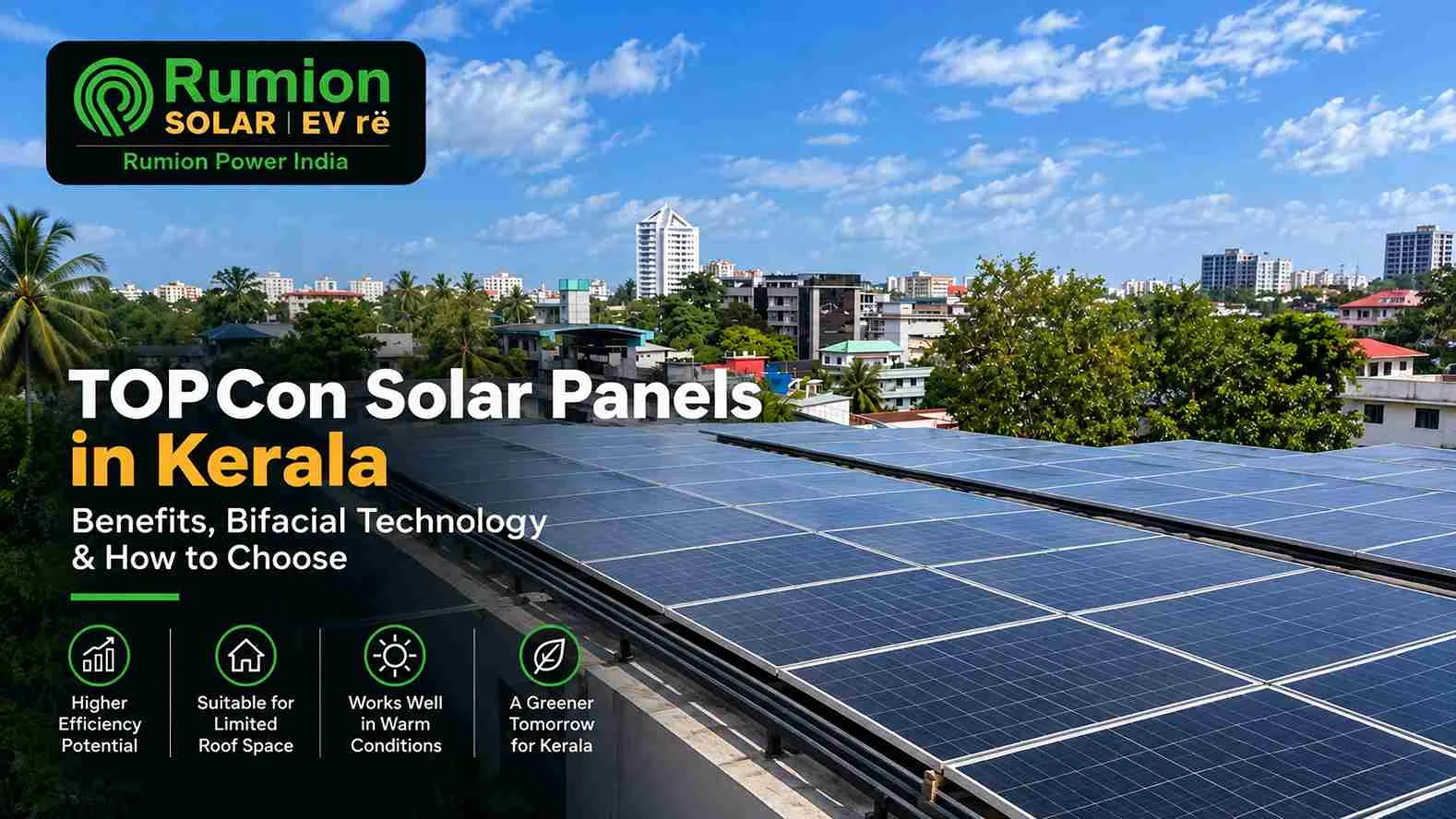
Solar panel technology has changed considerably in recent years. For homeowners and businesses in Kerala comparing rooftop solar options, terms such as N-type, TOPCon, bifacial, Mono PERC, module efficiency and temperature coefficient can make choosing a panel unnecessarily confusing.
One technology appearing increasingly in solar product specifications is the TOPCon solar panel. TOPCon stands for Tunnel Oxide Passivated Contact. It is a solar-cell architecture designed to reduce electrical losses within the cell and support efficient conversion of available sunlight into electricity.
But choosing a solar panel should not come down to the technology name alone. A high-performance module still needs to suit the available roof area, shading conditions, system design and requirements of the property.
For Kerala in particular, roof space, surrounding trees and buildings, heat, seasonal cloud cover, monsoon conditions and installation design can all influence real-world solar performance.
This guide explains what TOPCon technology means, how N-type TOPCon cells work, where bifacial technology fits in, the potential benefits of TOPCon panels and what Kerala buyers should actually compare before selecting a module.
What Is a TOPCon Solar Panel?
A TOPCon solar panel uses solar cells built with Tunnel Oxide Passivated Contact technology.
At the cell level, TOPCon uses a passivated-contact structure that includes a very thin oxide layer. The purpose of this architecture is to reduce electrical losses associated with charge-carrier recombination.
For a homeowner, the concept can be understood more simply. Sunlight reaches the solar cell, electrical charge carriers are generated, and the cell architecture is designed to reduce losses while those charges are collected.
The important distinction is that TOPCon describes technology used inside the solar cell. It does not, by itself, tell you everything about the finished solar module.
What Does N-Type Mean in a TOPCon Solar Panel?
You will often see products described as N-type TOPCon solar panels.
N-type refers to the type of silicon wafer used as the base of the solar cell. TOPCon refers to the passivated-contact architecture used in the cell.
The two terms are therefore related, but they do not mean exactly the same thing.
N-type TOPCon modules are now present in the Indian solar market, including products designed with bifacial configurations. For someone comparing rooftop panels, however, seeing “N-type” or “TOPCon” on a quotation should not be enough to make a final decision.
The specifications of the exact module model should also be checked.
How Does TOPCon Solar Cell Technology Work?
Every solar cell experiences different forms of electrical loss. One of these is recombination, where charge carriers generated by incoming light recombine before they can contribute effectively to useful electrical current.
TOPCon technology addresses losses around the cell contact through its tunnel-oxide passivated-contact architecture.
For a homeowner or business evaluating rooftop solar, it is not necessary to understand semiconductor physics in detail. The practical point is that TOPCon is a specific solar-cell architecture rather than simply a marketing term used for a high-wattage panel.
What Are the Benefits of TOPCon Solar Panels?
The exact performance of a solar module depends on the manufacturer, model and complete module construction. Buyers should therefore avoid assuming that every TOPCon solar panel will have identical specifications.
However, there are several reasons why TOPCon technology is relevant when comparing modern solar modules.
Higher Efficiency Potential
TOPCon architecture is used in modern high-efficiency solar-cell and module designs.
For a rooftop buyer, however, the most useful number is not a general claim about TOPCon technology. It is the module efficiency stated on the current datasheet of the exact commercial panel being offered.
Cell efficiency and finished-module efficiency should also not be treated as interchangeable figures.
For a broader explanation of how panel wattage, dimensions and efficiency relate to each other, read Rumion’s guide to solar panel efficiency in Kerala.
More Power From Limited Roof Area
Higher module efficiency can be particularly useful when usable rooftop space is limited.
If one module can provide greater rated power within approximately the same surface area as another, it may be possible to accommodate more system capacity within the available roof space.
That does not mean the highest-efficiency module is automatically the right choice for every property.
Water tanks, parapet walls, stair rooms, neighbouring buildings, trees, access areas and shading can all reduce the portion of a roof that can practically be used for solar modules.
Rumion’s guide to the roof area required for solar panels in Kerala explains why total roof area and practically usable solar-installation area can be different.
N-Type Module Technology
N-type silicon is commonly associated with TOPCon solar-cell architecture.
However, homeowners should not select a solar module purely because a quotation mentions N-type technology.
The better approach is to compare the actual module efficiency, rated power, dimensions, temperature coefficient, electrical characteristics and manufacturer documentation for the specific product being proposed.
Performance in Warm Conditions
Solar-module performance changes with cell temperature. As a solar module becomes hotter, its electrical output can decrease relative to its rated output under standard test conditions.
This makes temperature coefficient an important specification when comparing modules for warm rooftop environments.
The actual temperature coefficient varies between module models. Buyers should therefore check the manufacturer’s current datasheet rather than assuming that every TOPCon panel has the same temperature characteristics.
TOPCon and Bifacial Solar Panels Are Not Opposing Technologies
This is one of the most important distinctions to understand.
TOPCon and bifacial do not describe two competing categories of solar technology.
TOPCon describes the solar-cell architecture.
Bifacial describes a module design capable of making use of light reaching both the front and rear sides.
A solar module can therefore be both TOPCon and bifacial.
This is why you may see products described as N-type TOPCon bifacial solar panels.
Therefore, asking “TOPCon or bifacial—which is better?” is not technically the right comparison.
A more useful question is whether the TOPCon module being considered is monofacial or bifacial and, if it is bifacial, whether the proposed installation can make practical use of rear-side light.
How Does a TOPCon Bifacial Solar Panel Work?
The front of a bifacial solar module receives solar radiation in the conventional way.
The rear side is also capable of using light that reaches it, including reflected light from surfaces below and around the module.
How much rear-side contribution is possible depends on the installation.
Factors can include mounting configuration, clearance behind the module, surrounding surfaces, reflected light, shading and array geometry.
This is why a bifacial module should not automatically be assigned a fixed additional-generation percentage.
The word “bifacial” describes a capability of the module. It does not guarantee the same rear-side energy contribution on every rooftop.
Are Bifacial TOPCon Panels Useful on Kerala Rooftops?
They can be suitable, but the answer depends on the actual roof and installation design.
Consider a bifacial module installed with adequate rear clearance and useful reflected light reaching its back surface.
Now compare it with a bifacial module installed very close to a surface where relatively little useful light reaches the rear.
Both panels may technically be bifacial, but their rear-side contribution may differ.
This is why product technology and installation design should be considered together.
For a Kerala rooftop, the property should be assessed before assuming that choosing a bifacial module will automatically provide a particular increase in electricity generation.
TOPCon vs Mono PERC: What Is the Difference?
TOPCon and PERC are both solar-cell architectures, so comparing these two technologies is more meaningful than comparing TOPCon with bifacial.
PERC stands for Passivated Emitter and Rear Cell. It has been widely used in crystalline-silicon solar modules.
TOPCon uses a different passivated-contact architecture involving a tunnel-oxide layer and passivated contact.
For a consumer, however, the technology name alone should not determine which module to purchase.
The actual module specifications, product documentation, system requirements and suitability for the property are more useful when comparing available options.
Why TOPCon vs PERC vs Bifacial Is a Misleading Comparison
You may encounter online comparisons framed as “TOPCon vs PERC vs bifacial.”
This mixes different characteristics of a solar module.
TOPCon is a solar-cell architecture.
PERC is also a solar-cell architecture.
Bifacial refers to the ability of a module to make use of light reaching both sides.
A TOPCon module can therefore be bifacial. Bifacial should not be treated as a third competing cell architecture alongside TOPCon and PERC.
Understanding this distinction makes solar quotations and product specifications much easier to evaluate.
What Should Kerala Buyers Check When Choosing TOPCon Solar Panels?
The word TOPCon on a quotation should be the beginning of the evaluation rather than the end.
Several specifications and site conditions deserve attention.
1. Module Efficiency
Check the efficiency of the exact module model.
Higher module efficiency can be useful where roof area is constrained, but efficiency should be considered together with rated power and physical dimensions.
2. Rated Power
Check the module’s rated maximum power in watts.
Rumion Power India works with different solar-module technologies and wattage classes depending on project requirements and selected equipment.
The exact module proposed for a particular installation should therefore be confirmed rather than assuming that one wattage applies to every project.
3. Panel Dimensions
A higher-wattage panel can also be physically larger.
This is why wattage should not be evaluated in isolation.
Compare the module’s rated power, dimensions and efficiency together with the usable roof area.
4. Temperature Coefficient
Check the temperature coefficient of maximum power in the manufacturer’s datasheet.
This specification helps explain how module output changes as cell temperature rises above the reference test condition.
Do not assume one temperature coefficient applies to every TOPCon solar panel.
5. Bifacial Capability
If the proposed module is bifacial, ask how the planned mounting arrangement will allow useful light to reach its rear side.
The word “bifacial” alone does not tell you how much additional energy the rear surface will contribute at your property.
6. Product Certifications and Applicable Indian Requirements
Solar-module technology should not be evaluated separately from applicable product standards and regulatory requirements.
The Bureau of Indian Standards Scheme II Registration Scheme provides official information about products covered under the compulsory registration framework.
Where applicable to a particular project or scheme, buyers should also verify current requirements through the Ministry of New and Renewable Energy’s Approved List of Models and Manufacturers (ALMM) rather than relying on an outdated downloaded list or an unverified sales claim.
7. Manufacturer Datasheet
Ask for the current datasheet of the exact module model being proposed.
Depending on the product, useful specifications can include rated power, module efficiency, dimensions, temperature coefficient, electrical characteristics, mechanical characteristics and bifacial specifications where applicable.
Do not make a decision based only on brochure terms such as “N-type,” “TOPCon” or “high efficiency.”
8. Manufacturer Warranty Documentation
Warranty terms vary between manufacturers and products.
Check the current warranty documentation for the exact module rather than assuming that every TOPCon panel comes with identical product or performance warranty terms.
9. Roof Conditions
A technically advanced solar panel cannot compensate for unsuitable rooftop planning.
The system design should consider usable roof area, orientation, tilt, shading, rooftop obstructions and the proposed module arrangement.
Rumion’s guide to the best solar panel direction and tilt angle in Kerala explains why panel placement and roof conditions need to be considered as part of the complete system design.
10. Complete System Design
Solar modules are only one component of a rooftop solar system.
The inverter, mounting structure, electrical design, protection equipment, cabling, earthing and installation quality also matter.
A premium solar panel cannot correct an unsuitable overall system design.
How Kerala’s Climate Should Influence Panel Selection
Kerala-specific rooftop conditions deserve consideration, but they should not be turned into exaggerated product claims.
Heat
Solar modules operate outdoors, and their cell temperature can rise above the surrounding air temperature.
Check the temperature coefficient of the exact module being considered rather than relying on generic claims that a particular technology is unaffected by heat.
Monsoon and Cloud Cover
Solar PV modules can continue generating electricity when conditions are not perfectly clear, but changing solar irradiance affects output.
Kerala’s seasonal weather makes it more useful to evaluate expected system performance across varying conditions rather than judging a solar module from an ideal sunny-day figure.
Shading
Trees, neighbouring buildings, water tanks, parapet walls and rooftop structures can create shade.
Panel technology does not eliminate the need for a proper shade assessment.
Roof Area
Where usable installation space is limited, module efficiency and power density become particularly relevant.
Available roof area should be assessed after accounting for actual obstructions, access requirements and layout constraints rather than using the building’s total roof dimensions alone.
Does a TOPCon Solar Panel Automatically Generate More Electricity?
Not automatically in every installation.
TOPCon technology can be used in high-efficiency module designs, but real-world electricity generation depends on the complete system and the site.
Relevant factors include solar irradiance, module orientation, tilt, shading, temperature, system capacity, inverter configuration, electrical losses, module characteristics and installation quality.
This is why two properties using similar modules can still produce different amounts of electricity.
TOPCon technology should be treated as one part of the overall solar-system design rather than as a standalone generation guarantee.
Are TOPCon Panels Better for Limited Roof Space?
They can be particularly useful when the selected TOPCon module provides high efficiency and suitable power density.
If a homeowner wants a particular system capacity but has limited shade-free roof area, fitting more rated capacity within the usable space may become important.
Instead of asking only which panel has the highest wattage, compare the usable roof space, module dimensions, rated power, module efficiency, number of modules that can practically fit, shading and layout requirements.
This connects module selection directly to the actual property.
Should You Choose the Highest-Wattage TOPCon Panel?
Not necessarily.
A higher wattage number does not automatically mean that a solar module is more efficient or more suitable for a particular roof.
A physically larger module may have a higher rated output partly because it has a larger surface area.
When comparing modules, consider rated wattage together with physical dimensions and module efficiency.
The most appropriate option is the one that works effectively within the complete rooftop system design.
Questions to Ask Before Accepting a TOPCon Solar Quotation
Before finalising a solar module, consider asking:
What is the exact manufacturer and module model?
Is the module N-type TOPCon?
Is the module monofacial or bifacial?
What is its rated power?
What is its module efficiency?
What are its physical dimensions?
What is its temperature coefficient?
Which current Indian certifications or registrations apply to the exact model?
Where applicable, does the proposed module meet current ALMM requirements?
Can I see the manufacturer’s current datasheet?
What are the manufacturer’s current warranty terms?
How many modules are proposed?
How will the modules be positioned on my roof?
Has rooftop shading been assessed?
If bifacial modules are proposed, how does the installation design account for rear-side light?
These questions are more useful than simply asking whether TOPCon is “better.”
Choosing TOPCon Solar Panels With Rumion Power India
TOPCon and bifacial modules are among the solar technologies used by Rumion Power India. Module selection can vary according to project requirements and the equipment selected.
For a rooftop solar system, the appropriate approach is to evaluate the technology alongside the property itself.
That means considering roof space, orientation, shading, system requirements, module specifications, inverter selection and the complete installation design before finalising equipment.
You can explore Rumion Power India’s solar services in Kerala or visit Rumion Power India to discuss a site-specific rooftop solar requirement.
Frequently Asked Questions
What is a TOPCon solar panel?
A TOPCon solar panel uses solar cells incorporating Tunnel Oxide Passivated Contact technology. TOPCon is a solar-cell architecture designed to reduce electrical losses associated with the cell contacts.
What does TOPCon stand for?
TOPCon stands for Tunnel Oxide Passivated Contact.
What is an N-type solar panel?
N-type refers to the type of silicon base used in a solar cell. N-type silicon is commonly associated with TOPCon technology, but N-type and TOPCon describe different aspects of the cell.
Is every N-type solar panel TOPCon?
No. N-type describes the silicon material, while TOPCon describes a particular solar-cell architecture. Check the manufacturer’s specifications for the exact technology used in a module.
Is a TOPCon solar panel the same as a bifacial solar panel?
No. TOPCon describes the solar-cell architecture, while bifacial describes the ability of a module to make use of light reaching both its front and rear sides.
A solar panel can be both TOPCon and bifacial.
What is a TOPCon bifacial solar panel?
It is a solar module that combines TOPCon cell technology with a bifacial module design.
TOPCon describes the cell architecture, while bifacial capability means that the module can use light reaching its rear side as well as its front.
Are TOPCon solar panels suitable for Kerala?
TOPCon modules can be considered for residential and commercial solar projects in Kerala, but suitability depends on the exact module and property.
Module efficiency, temperature coefficient, usable roof area, shading, orientation, system design and applicable product requirements should all be considered.
Are TOPCon panels useful for small roofs?
High-efficiency TOPCon modules can be useful where usable roof area is constrained because module power density can become more important.
The actual benefit depends on the dimensions and efficiency of the exact module and the available roof layout.
Does a bifacial TOPCon panel always generate more electricity?
A bifacial module can use light reaching its rear side, but the additional contribution depends on installation conditions such as mounting configuration, rear clearance, reflected light and shading.
A fixed additional-generation percentage should not be assumed for every rooftop.
How should I compare TOPCon solar panels?
Compare the exact module’s rated power, efficiency, dimensions, temperature coefficient, electrical characteristics, bifacial specifications where applicable, Indian product compliance information, manufacturer documentation and warranty terms.
Then consider those specifications alongside the actual roof conditions and complete solar-system design.
Final Takeaway
TOPCon is not simply another name for a high-wattage solar panel. It is a specific solar-cell architecture.
N-type describes the silicon base commonly associated with TOPCon products, while bifacial describes whether a module can make use of light reaching both its front and rear surfaces.
Understanding these distinctions helps prevent misleading comparisons, particularly when TOPCon, PERC and bifacial are incorrectly treated as three directly competing technologies.
For Kerala buyers, the technology name should be the beginning of the comparison rather than the end.
Check the exact module efficiency, wattage, dimensions, temperature coefficient, bifacial characteristics where relevant, applicable Indian product requirements and manufacturer documentation.
Then evaluate those specifications against the actual roof area, shading, orientation and complete system design.
A well-selected solar panel is one that suits the property and works effectively as part of the complete rooftop solar system.