
How Much Roof Area Is Required for 1kW, 3kW, 5kW & 10kW Solar Systems in Kerala?
One of the first questions homeowners ask before installing rooftop solar is: How much roof area do I actually need?
It sounds like a simple calculation, but roof size alone does not decide how much solar capacity can be installed. Two houses with the same terrace area can support very different solar layouts because panel size, module wattage, roof shape, shading, water tanks, staircase rooms, mounting structures and other site conditions all affect the usable space.
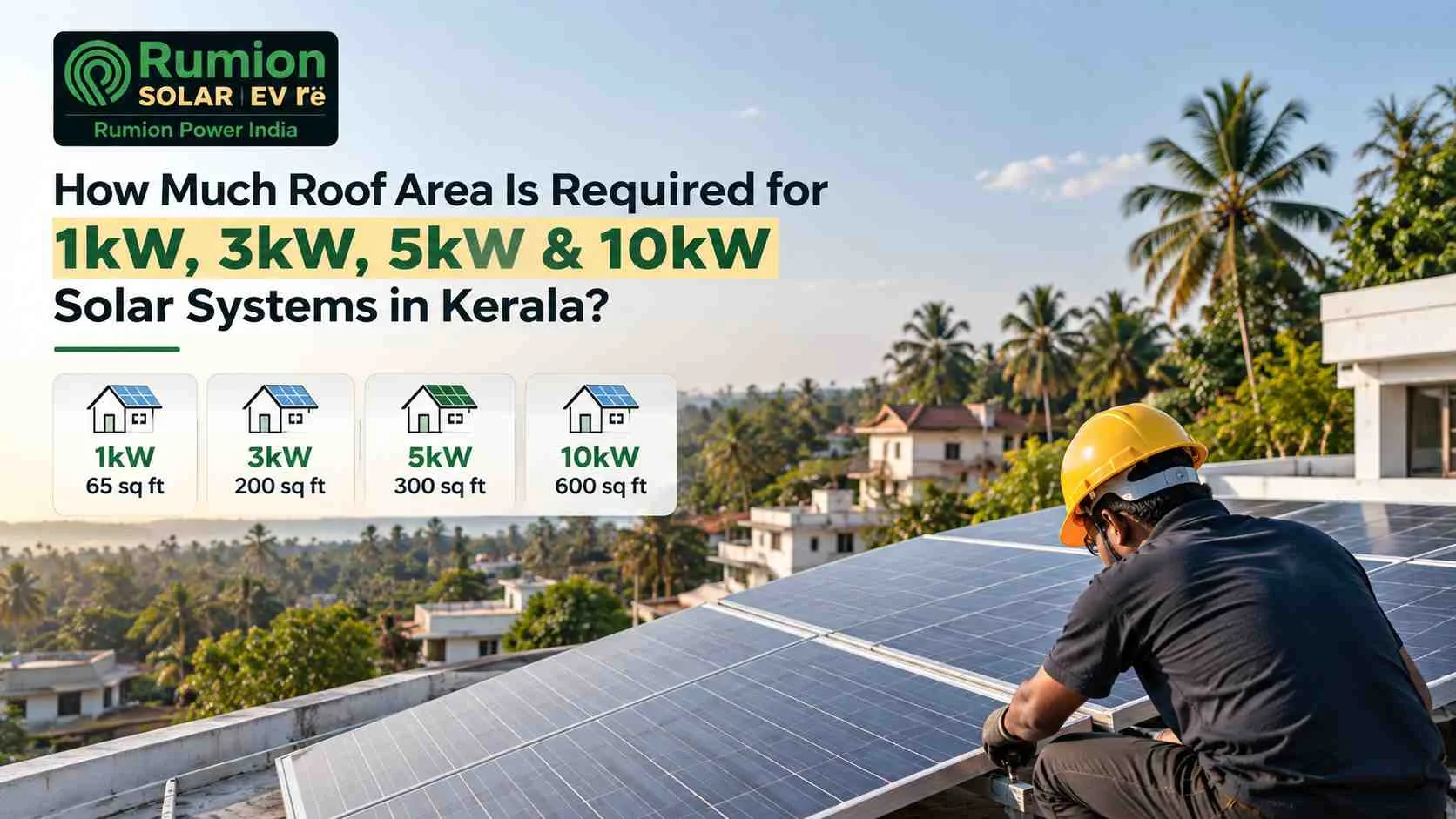
For initial planning, Rumion Power India normally considers approximately 65 sq ft of usable rooftop area for 1kW, 200 sq ft for 3kW, 300 sq ft for 5kW and 600 sq ft for 10kW.
These are practical planning figures, not fixed minimum requirements for every property. The final area should always be confirmed after assessing the actual roof and the solar modules proposed for the project.
Roof Area Required for Solar Panels: Quick Reference
| Solar System Capacity | Approximate Usable Rooftop Area |
|---|---|
| 1kW | 65 sq ft |
| 3kW | 200 sq ft |
| 5kW | 300 sq ft |
| 10kW | 600 sq ft |
These figures are particularly useful when you are at the early planning stage and want to know whether your Kerala home may have sufficient space for the system capacity you are considering.
There is an important distinction, however, between total roof area and usable roof area.
A 500 sq ft terrace does not necessarily provide 500 sq ft for solar panels. Some portions may be shaded, occupied by a water tank or staircase structure, unsuitable because of the roof layout, or needed for practical access.
The Government of India’s rooftop solar guidance provides another useful reference. It states that a 1kW rooftop solar system generally requires about 10 square metres of shadow-free area, while noting that the actual requirement can vary depending on solar-module efficiency and panel placement.
This is why different roof-area estimates can all be reasonable in different situations. The final answer depends on the system being designed and the property where it will be installed.
What Is Usable Rooftop Area?
When planning rooftop solar, the important measurement is not simply the overall dimensions of the terrace. What matters is the portion of the roof that can realistically be used for the solar array.
For example, a house may have a large terrace but also have:
- A water tank
- A staircase headroom
- Parapet walls
- Plumbing or utility equipment
- Trees close to the building
- Nearby buildings that create shade
- Multiple roof levels
- Sections that need to remain accessible
After these factors are considered, the usable area may be considerably smaller than the total roof area.
A good solar layout therefore begins with an assessment of the actual property rather than a simple calculation based on the building’s overall dimensions.
Area Required for a 1kW Solar Panel System
For a 1kW solar system, Rumion normally considers approximately 65 sq ft of usable rooftop area as an initial planning figure.
This does not mean every 1kW system will occupy exactly 65 sq ft.
The number and dimensions of solar panels depend on the modules selected. Rumion currently works with different module technologies and commonly uses panels in approximately the 540W to 700W range, depending on the project requirements and equipment selection.
A system using higher-wattage modules may require fewer individual panels to reach a particular capacity than a system using lower-wattage modules. However, higher wattage does not automatically mean that the panel itself occupies proportionally less space.
The actual module dimensions still need to be considered.
The Government of India’s rooftop solar guidance uses approximately 10 square metres of shadow-free area for 1kW as a general reference and specifically notes that the actual area can vary with module efficiency and placement.
Therefore, 65 sq ft should be treated as Rumion’s indicative usable-area planning figure rather than a universal rule for every 1kW installation.
Area Required for a 3kW Solar Panel System
If you are checking the area required for a 3kW solar panel system, Rumion normally considers approximately 200 sq ft of usable rooftop area.
A 3kW system can be suitable for many residential applications, but available roof area is only one part of the sizing decision.
Consider two houses that each have around 200 sq ft available.
The first house may have a simple rectangular terrace with very little shading. The second may have the same total area divided into several sections, with a water tank on one side and afternoon shading from a neighbouring building.
Although the measured area is similar, the solar layout could be quite different.
For this reason, homeowners should not assume that having 200 sq ft automatically guarantees that a particular 3kW configuration will fit. The dimensions of the proposed panels and the actual roof layout should be checked first.
Area Required for a 5kW Solar Panel System
For a 5kW solar system, Rumion normally considers approximately 300 sq ft of usable rooftop area for initial planning.
At this capacity, the arrangement of the available space becomes increasingly important.
A single unobstructed 300 sq ft roof section provides different design possibilities from the same area divided between multiple roof sections.
The installer needs to determine where the panels can be positioned, whether significant shading is present, how the mounting structure will be arranged and whether existing rooftop features will interfere with the proposed layout.
Homeowners considering a 5kW system should therefore think in terms of usable solar installation area, rather than simply checking whether their terrace measures 300 sq ft.
Area Required for a 10kW Solar Panel System
Rumion’s indicative planning figure for a 10kW solar system is approximately 600 sq ft of usable rooftop area.
Larger systems make site-specific design even more important because a greater number of modules must be incorporated into the available roof.
A 600 sq ft open rectangular terrace may be relatively straightforward to assess. The same total area spread over several roof sections with different orientations, elevations and shading conditions requires a more detailed layout.
The final design also needs to account for the selected modules, mounting arrangement and site conditions.
For this reason, a 10kW system should not be planned simply by multiplying a fixed square-foot figure per kilowatt.
Why Do Roof-Area Estimates Differ?
If you research solar-panel roof requirements online, you may find several different answers for the same system capacity.
That does not necessarily mean one figure is correct and all the others are wrong.
There are several reasons why solar roof-area estimates differ.
1. Solar Panel Wattage
Solar systems are created by combining individual modules to reach the required capacity.
For example, reaching approximately 5kW with one module rating may require a different number of panels than reaching a similar capacity with another module rating.
Rumion currently uses different solar module options, with common panel wattages ranging approximately from 540W to 700W.
The panel specification selected for a project therefore influences the final array layout.
2. Physical Panel Dimensions
Wattage alone does not tell you how much roof space a panel occupies.
Two panels with different power ratings can also have different physical dimensions.
A proper roof-space calculation should therefore use the actual length and width of the proposed module rather than estimating space only from its wattage.
3. Solar Module Efficiency
Module efficiency influences how effectively the available panel surface converts sunlight into electricity.
This is one of the reasons official rooftop-solar guidance states that actual area requirements can vary according to module efficiency and placement.
When roof space is limited, panel selection becomes an important part of the overall system design.
4. Roof Shape
Not every Kerala home has a large, uninterrupted rectangular terrace.
Properties can have RCC roofs, sloped roofs, tiled sections, sheet roofs or combinations of different roof levels.
Even a large roof may provide limited continuous space if it contains several permanent structures.
The actual geometry of the roof therefore affects how efficiently the available space can be used.
5. Shading
A physically empty section of roof is not necessarily a good location for a solar panel.
Shade may come from:
- Trees
- Nearby buildings
- Water tanks
- Staircase structures
- Parapet walls
- Other rooftop obstructions
Shading can also change throughout the day and during different periods of the year.
This makes a proper shading assessment important before the final panel layout is decided.
For more information about orientation and roof positioning, read Rumion’s guide to solar panel angle in Kerala.
6. Mounting Structure
Solar modules need a suitable mounting structure rather than simply being placed directly on the roof.
The mounting arrangement depends on the roof and the proposed system design. Panel positioning, orientation and structural requirements can therefore influence how much of the available space can actually be used.
The Government of India’s rooftop solar guidance identifies the module mounting structure as the support system that holds solar PV panels in position and notes that rooftop modules are normally installed at a particular angle and orientation.
7. Access and Existing Rooftop Features
A rooftop remains part of the building even after solar panels are installed.
Water tanks and other equipment may still need to be accessed. The installation should also take the actual roof configuration and practical requirements into account.
This is another reason why covering every available square foot with panels is not necessarily the right approach.
8. Roof Condition and Site Requirements
Roof type and condition can affect how a system is designed and installed.
Rumion considers factors such as:
- Roof type and condition
- Building height and access
- Elevated or customised mounting structures
- Additional civil or structural requirements
- Cable routing
- Electrical and earthing requirements
- Panel and inverter selection
- Other site-specific requirements
A site assessment helps identify these conditions before the final system configuration is confirmed.
Does Panel Wattage Change the Roof Area Required?
Yes, panel wattage can affect the layout, but it should not be considered in isolation.
Suppose two systems are designed to achieve approximately the same total capacity. A system using higher-wattage modules may require fewer modules than one using lower-wattage modules.
However, fewer panels do not automatically mean dramatically less roof area because the physical dimensions of the modules may also differ.
The better approach is to consider three things together:
Panel wattage + panel dimensions + module efficiency
These specifications can then be applied to the actual dimensions of the usable roof.
Rumion currently works with solar modules in approximately the 540W–700W range, depending on system design and equipment selection.
The final panel choice should be based on the complete project requirements rather than simply choosing the highest wattage available.
Does Kerala’s Climate Affect Solar Roof Planning?
Kerala’s climate makes proper site assessment particularly important.
The state experiences substantial seasonal rainfall, and properties can also have vegetation and surrounding buildings that influence shading conditions.
However, there is no universal rule that every Kerala solar installation requires a fixed amount of additional roof area.
The correct approach is to assess each property individually.
Important factors include:
- Available usable area
- Roof orientation
- Shading
- Roof type and condition
- Selected modules
- Mounting arrangement
- Existing rooftop structures
- Site access
A well-planned solar installation should respond to the actual site rather than applying the same layout to every Kerala home.
Roof Area Alone Should Not Decide Your Solar System Size
One of the most important points for homeowners to understand is that having enough roof space does not automatically mean you need the largest system that can fit there.
Suppose your roof could physically accommodate a 10kW system. That does not necessarily mean 10kW is the appropriate capacity for your home.
Solar-system sizing should also consider your electricity requirements.
Likewise, a household may have significant electricity consumption but limited usable roof space. In that situation, module selection and system design become particularly important.
Rumion’s solar planning process considers factors including electricity consumption, available installation area, roof orientation and shading, property conditions, grid availability, backup requirements and the proposed system configuration.
In simple terms:
Roof area helps determine what can fit.
Electricity consumption helps determine what you need.
The final system should consider both.
How to Estimate Whether Your Roof Has Enough Space
You can make a preliminary assessment before arranging a professional site visit.
Start by estimating your total roof dimensions.
Then identify areas occupied by permanent structures such as water tanks and staircase rooms.
Next, look for areas that experience substantial shading from trees, neighbouring buildings or other obstructions.
What remains gives you a better idea of the potentially usable solar area.
You can then compare that space with Rumion’s indicative planning figures:
- 1kW — approximately 65 sq ft
- 3kW — approximately 200 sq ft
- 5kW — approximately 300 sq ft
- 10kW — approximately 600 sq ft
This is useful for preliminary planning, but it should not replace a proper site assessment.
The final layout should be prepared using the specifications of the actual panels and the conditions of the property.
What Should Be Checked During a Solar Site Assessment?
Before confirming whether a 1kW, 3kW, 5kW or 10kW system can be installed, several practical questions should be answered.
How Much Usable Roof Area Is Available?
The installer should identify the portions of the roof that can realistically accommodate the proposed modules.
Is the Roof Affected by Shade?
Trees, neighbouring structures and rooftop obstructions should be considered when determining the panel layout.
What Is the Roof Orientation?
Orientation and the available roof geometry influence how panels can be positioned.
You can learn more in Rumion’s detailed guide on solar panel direction and tilt angle in Kerala.
What Is the Condition of the Roof?
The roof and proposed installation area should be assessed before the mounting arrangement is finalised.
Which Solar Modules Will Be Used?
The actual module wattage and dimensions are necessary for preparing an accurate panel layout.
What System Capacity Does the Property Need?
Electricity consumption and energy requirements should be considered alongside the available space.
Are There Site-Specific Installation Requirements?
Building access, roof configuration, electrical requirements and other site conditions can influence the final project.
Rumion provides support from site assessment and system sizing through installation, testing and commissioning as part of its solar project process.
Roof Area and KSEB Solar Feasibility Are Not the Same Thing
For homeowners planning an on-grid solar system in Kerala, another important distinction is between rooftop suitability and grid feasibility.
Having enough roof space does not by itself complete the technical process for a grid-connected solar installation.
The roof assessment determines whether the proposed solar array can be appropriately accommodated on the property.
System sizing considers electricity requirements and the appropriate capacity.
Grid-connected projects also need to follow the applicable KSEB process.
Rumion has explained this separately in its guide to the KSEB solar feasibility check and DTR capacity.
Thinking about these as separate questions makes the planning process easier:
Roof suitability: Is there enough appropriate space for the proposed solar array?
System sizing: What capacity is suitable for the property’s electricity requirements?
Grid process: What technical and procedural requirements apply to connecting the proposed system?
A properly planned on-grid installation needs to consider all three.
Don’t Forget Electrical Safety When Planning the Roof
Rooftop space is only one part of a complete solar installation.
A solar system also includes an inverter, cabling, protection equipment, earthing and other electrical components.
These should be considered during system planning rather than after the panels have already been positioned.
For homeowners who want to understand this part of an installation in more detail, Rumion’s solar earthing in Kerala guide explains the role of earthing and electrical safety in rooftop solar systems.
The objective should be a complete system design, not simply fitting as many panels as possible onto the available roof.
1kW vs 3kW vs 5kW vs 10kW Solar Roof Area
Here is a simple comparison for initial planning:
| System Capacity | Approximate Usable Roof Area | Important Factors to Check |
|---|---|---|
| 1kW | 65 sq ft | Panel dimensions, shading and usable space |
| 3kW | 200 sq ft | Roof layout, electricity requirement, shading and panel configuration |
| 5kW | 300 sq ft | Usable roof sections, module selection, mounting arrangement and site conditions |
| 10kW | 600 sq ft | Complete roof layout, system requirement, site conditions and grid process |
These figures are based on Rumion’s current indicative planning inputs and should be confirmed for the individual property before installation.
Frequently Asked Questions
How much area is required for a 1kW solar panel system?
Rumion normally considers approximately 65 sq ft of usable rooftop area for a 1kW system as an initial planning figure. The Government of India’s rooftop solar guidance gives around 10 square metres of shadow-free area as a general reference for 1kW and notes that actual requirements can vary depending on module efficiency and placement.
How much area is required for a 3kW solar panel system?
For initial planning, Rumion normally considers approximately 200 sq ft of usable rooftop area for a 3kW solar system. The final requirement depends on the panels selected, roof layout, shading, mounting arrangement and other site conditions.
How much area is required for a 5kW solar panel system?
Rumion’s indicative planning figure for a 5kW solar system is approximately 300 sq ft of usable rooftop area. The actual requirement should be confirmed after evaluating the property and preparing the proposed panel layout.
How much area is required for a 10kW solar panel system?
For a 10kW solar system, Rumion normally considers approximately 600 sq ft of usable rooftop area. Larger systems especially benefit from a site-specific layout because roof shape, obstructions and panel arrangement can significantly influence how the available area is used.
Is 200 sq ft enough for a 3kW solar system?
Around 200 sq ft is Rumion’s indicative usable-area figure for initial planning of a 3kW system. However, 200 sq ft of total terrace area is not necessarily the same as 200 sq ft of usable solar area. Shading, water tanks, staircase structures, roof geometry and the selected panels should be checked before confirming the system.
Is 300 sq ft enough for a 5kW solar system?
Approximately 300 sq ft is Rumion’s current indicative planning figure for a 5kW system. Whether a particular 300 sq ft roof is suitable depends on how much of that space is actually usable and sufficiently free from obstructions and problematic shading.
Does a higher-wattage solar panel require less roof space?
Higher-wattage panels can reduce the number of modules needed to reach a target capacity, but this does not automatically mean a proportional reduction in roof area. Physical panel dimensions and module efficiency also need to be considered.
Can solar panels be installed if my roof has partial shade?
A roof with partial shading may still have suitable areas for solar panels. The location and timing of the shade should be assessed before the array layout is finalised. System design and equipment selection may also influence how a particular site is approached.
Should I choose solar capacity based only on roof area?
No. Available roof area is only one part of solar-system sizing. Electricity consumption, usable installation area, shading, module selection, system type and site conditions should also be considered.
Do I need a site survey before installing rooftop solar?
A site assessment is strongly useful because it allows the proposed system to be planned around the actual roof rather than an online estimate. Rumion’s installation process includes assessment of rooftop space, orientation, shading and installation conditions before system planning.
Final Takeaway
If you are trying to determine whether your Kerala home has enough space for rooftop solar, the following figures provide a practical starting point:
1kW — approximately 65 sq ft
3kW — approximately 200 sq ft
5kW — approximately 300 sq ft
10kW — approximately 600 sq ft
These are Rumion Power India’s indicative usable rooftop-area figures. They should not be treated as fixed requirements for every property.
The actual space required depends on the solar modules selected, their physical dimensions and efficiency, roof geometry, shading, mounting arrangement and other site-specific conditions.
Most importantly, the largest solar system that fits on your roof is not automatically the right solar system for your home. Capacity should be planned around both your usable roof space and your electricity requirements.
Rumion Power India provides solar solutions across Kerala with support covering site assessment, system sizing and design, installation, KSEB-related processes, testing, commissioning and applicable after-sales assistance.
If you are unsure whether your roof can accommodate the solar capacity you need, contact Rumion Power India for a site assessment and system-planning consultation.
Official reference: Government of India — National Portal for Rooftop Solar FAQ